Your car’s wheels play a crucial role in delivering a smooth, stable, and comfortable driving experience. Properly aligned and balanced wheels help your vehicle handle confidently, improve tyre life, enhance fuel efficiency, and ensure even tyre wear. They also contribute to better steering response and overall driving comfort, making every journey safer and more enjoyable.
However, everyday driving conditions such as potholes, speed breakers, rough roads, and minor impacts can gradually affect wheel alignment and balance. Therefore, regular car wheel alignment and balancing services are essential.
Find below why you should never skip car wheel alignment and balancing services.
1. Prevents Uneven and Premature Tyre Wear
Ignoring car wheel alignment accelerates uneven tyre wear, leading to premature tyre replacement and higher ownership costs.
Why this matters:
- Misaligned wheels don’t make even contact with the road
- Inner or outer edges wear far faster than the rest of the tread
- Cupping or feathering can develop across the tread
- Wheels out of balance cause vibration-driven wear patterns
- Visible after just a few thousand kilometres of misalignment
- Tyres often need replacement 30–50% sooner than expected
Replacing tyres costs much more than the cost of a routine car wheel alignment and balancing service.
2. Extends Tyre Lifespan and Saves Money
Regular car wheel alignment and balancing services add years of usable life to the tyres.
Why this matters:
- Well-aligned wheels wear evenly across the entire tread
- Balanced wheels prevent vibration-induced wear
- Tyres last their full expected 40,000–60,000 km lifespan
- You replace tyres less often over your ownership period
- Significant long-term savings on tyre costs
- Better resale value when tyres still have life remaining
Over the life of a car, skipping these services can cost you the price of an entire extra set of tyres or more.
3. Improves Vehicle Handling and Stability
Car wheel alignment and balancing directly affect how your car handles, especially during fast manoeuvres and emergencies.
Why this matters:
- Well-aligned wheels keep the car tracking straight without pulling
- Balanced wheels ensure smooth and vibration-free driving
- Better cornering response through tight turns
- Reduced body roll during quick manoeuvres
- Predictable handling in emergency situations
- More confident driving at highway speeds
A car that handles predictably is a car that’s safer to drive, especially in unpredictable traffic conditions.
4. Enhances Braking Performance and Safety
Properly aligned and balanced wheels are essential for safe and controlled braking, particularly in emergencies.
Why this matters:
- Aligned wheels maintain proper tyre contact during braking
- Balanced wheels prevent shuddering or vibration during stops
- Even brake pad and disc wear for consistent performance
- No pulling to one side during hard braking
- Shorter stopping distances in emergencies
- ABS works effectively with stable wheel behaviour
Worn or misaligned wheels can increase stopping distances by up to 20%, which can be the difference between avoiding an accident and not.
5. Improves Fuel Efficiency
Misaligned and unbalanced wheels create extra resistance that forces the engine to work harder, directly costing you fuel.
Why this matters:
- Misaligned wheels cause excess rolling resistance
- Unbalanced wheels create vibration that wastes energy
- Engine works harder to maintain speed
- Fuel efficiency drops by up to 10% with poor alignment
- Higher monthly fuel bills for every kilometre driven
- A timely service often pays for itself in fuel savings within months
For Delhi drivers facing high fuel prices, this benefit makes regular car wheel alignment and balancing cost-effective.
6. Reduces Driver Fatigue on Long Drives
Misaligned wheels make driving more tiring than it needs to be, a comfort issue that becomes a safety issue on long drives.
Why this matters:
- Constant steering corrections to keep the car straight cause fatigue
- Vibrations through the steering wheel strain your hands and arms
- Pulling to one side demands continuous mental focus
- Tiring drives affect concentration and reaction time
- Long-distance commutes become more comfortable
Properly aligned and balanced wheels let the car drive itself in a straight line, exactly as it should.
7. Prevents Damage to Suspension Components
Skipping car wheel alignment and balancing puts continuous stress on suspension parts, leading to expensive cascading damage.
Why this matters:
- Unbalanced wheels transmit vibrations through the suspension
- Misaligned wheels strain tie rods, ball joints, and control arms
- Premature wear of suspension bushings and bearings
- Eventual failure of shock absorbers and struts
- A small alignment fee prevents major repair bills
The cascading damage from skipped alignment is often the most expensive consequence and entirely preventable.
8. Reduces Vibration in the Steering Wheel
Vibrations in the steering wheel are one of the most common signs of wheel imbalance.
Why this matters:
- Unbalanced wheels cause buzzing or shaking through the steering
- Vibrations are usually felt at specific speeds (60–100 km/h)
- Steady and comfortable steering restored after balancing
- Reduces wear on steering components
- Better cabin comfort at all speeds
- More confident driving without distracting vibrations
A car that doesn’t vibrate at highway speeds is more pleasant and comfortable to drive.
9. Maintains Effective ABS and Electronic Stability Systems
Modern safety systems rely on consistent wheel behaviour and skipping car wheel alignment and balancing compromises their effectiveness.
Why this matters:
- ABS works better with proper tyre contact
- Electronic Stability Control (ESC) activates correctly with aligned wheels
- Traction Control functions as designed
- Sensors receive accurate data from balanced wheels
- Stability systems respond properly to emergencies
- Full effectiveness of modern safety tech preserved
Your car’s most sophisticated safety features depend entirely on properly aligned and balanced wheels to work correctly.
10. Lowers Overall Maintenance Costs
Skipping car wheel alignment and balancing can increase overall maintenance costs.
Why this matters:
- Tyres replaced earlier than necessary
- Suspension components fail prematurely
- Brake parts wear unevenly
- Wheel bearings stressed and replaced sooner
- Steering components strained and damaged
- Total cost of ownership rises significantly
Regular car wheel alignment and balancing is one of the smartest investments any car owner can make to control long-term ownership costs.
What’s the Difference Between Car Wheel Alignment and Balancing?
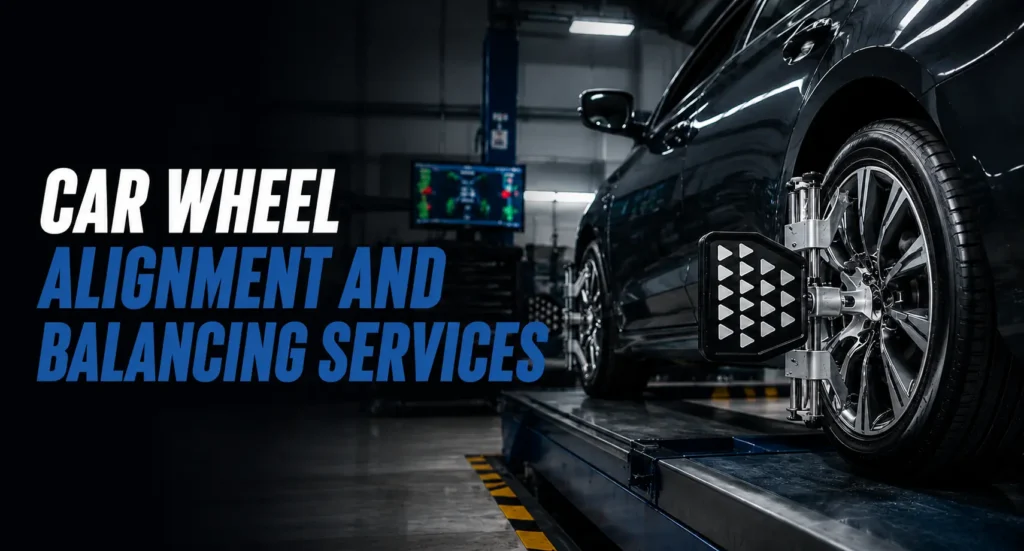
Wheel alignment and wheel balancing are separate maintenance services, each designed to improve vehicle stability, tyre longevity, and driving comfort.
Wheel Alignment:
- Adjusts wheel angles (camber, caster, toe) to manufacturer specifications
- Ensures wheels point in the right direction
- Affects tracking, handling, and tyre wear patterns
- Performed using computerised alignment machines
Wheel Balancing:
- Equalises weight distribution around the tyre and wheel
- Eliminates vibration from heavy or light spots
- Uses small balance weights attached to the rim
- Performed on dedicated balancing machines
Both services complement each other, skipping either one compromises the benefits of the other.
How Often Should You Get Car Wheel Alignment and Balancing?
Most experts recommend the following schedule for Delhi conditions:
- Wheel alignment: every 10,000–15,000 km
- Wheel balancing: every 8,000–10,000 km, or with every tyre rotation
- Both immediately: after fitting new tyres
- Both immediately: after a significant pothole or kerb impact
- Both immediately: if you notice signs of misalignment or vibration
- Before long road trips: for safer and more comfortable driving
Delhi roads with their potholes, broken patches, and unpredictable surfaces generally require more frequent alignment and balancing.
Signs You Need Wheel Alignment or Balancing Right Now
Knowing when to book these services helps you stay proactive. Watch for:
- Car pulling to one side while driving straight
- Uneven or premature tyre wear
- Steering wheel off-centre while driving straight
- Vibration in the steering wheel at certain speeds
- Vibration through the floor or seats
- Loose or imprecise steering
- Squealing tyres during normal turns
- Pulling under hard braking
Don’t ignore any of these signs, the longer you delay, the more damage builds up.
Wheel alignment and balancing may be simple maintenance services, but their impact on your vehicle is significant. They help maximise tyre life, enhance driving comfort, improve steering stability, and support optimal fuel economy.
Making car wheel alignment and balancing part of your regular maintenance schedule can go a long way toward preserving your car’s performance and overall driving experience.
Get the best car repair and service at Auto Car Repair in Delhi NCR.
Frequently Asked Questions (FAQs)
1. Why should I not skip car wheel alignment and balancing services?
Regular wheel alignment and balancing service help extend tyre life, improve handling and braking, enhance fuel efficiency, reduce steering vibrations, and protect suspension components from unnecessary wear. By maintaining optimal vehicle performance and safety, these services can help prevent costly repairs and reduce overall ownership costs in the long run.
2. How often should I get wheel alignment and balancing done?
Experts recommend wheel alignment every 10,000–15,000 km and wheel balancing every 8,000–10,000 km (or with every tyre rotation). You should also get both done immediately after fitting new tyres, after any significant pothole or kerb impact, before long road trips, and anytime you notice signs of misalignment or vibration.
3. What’s the difference between wheel alignment and balancing?
Wheel alignment adjusts wheel angles (camber, caster, and toe) to manufacturer specifications, ensuring wheels point in the right direction for proper tracking, handling, and tyre wear.
Wheel balancing equalises weight distribution around the tyre and wheel using small weights attached to the rim, eliminating vibration caused by heavy or light spots.
Both services complement each other and are equally important.
4. Can skipping car wheel alignment and balancing affect fuel efficiency?
Yes, significantly. Misaligned and unbalanced wheels create extra rolling resistance, force the engine to work harder, and can reduce fuel efficiency by up to 10%. The extra fuel consumed due to misaligned or unbalanced wheels can add up quickly, making regular servicing a cost-effective investment.
5. What are the signs my car needs car wheel alignment or balancing?
Common signs include the car pulling to one side while driving straight, uneven or premature tyre wear, the steering wheel sitting off-centre while driving straight, vibration in the steering wheel at certain speeds, vibration through the floor or seats, loose or imprecise steering response, squealing tyres during normal turns, and pulling under hard braking. If you notice any of these, book a wheel alignment and balancing service promptly.
Auto Car Repair in Delhi NCR
Auto Car Repair provides complete automotive care to keep your vehicle performing at its best. From routine servicing and diagnostics to accidental repairs, our experienced technicians deliver reliable solutions with quality workmanship, helping ensure a safe, smooth, and hassle-free driving experience.
Book your car service at Auto Car Repair today!
| Showroom Location | Address | Call/Whatsapp Number | Nearby Locations |
| Moti Nagar | 57, Rama Rd, Block C, Najafgarh Road Industrial Area, New Delhi, Delhi, 110015 | 098704 00861 | Ramesh Nagar, Punjabi Bagh, Rajouri Garden, Mayapuri, Kirti Nagar, Janakpuri, Sudarshan Park, Chand Nagar, ESI, |
| Gurugram | Unit-1 Plot No 29 & 30, near, Kargil Shaheed Sukhbir Singh Yadav Marg, Info Technology Park, Sector 34, Gurugram, Haryana 122004 | 098104 46692 | Sec 37 Gurugram, Sec 37B Gurugram, Sec 72A Gurugram, Sec 74 Gurugram, Sec 35 Gurugram, Sec 36 Gurugram, |
| Noida | H-142, near Ananda Corporate Office, H Block, Sector 63, Noida, Uttar Pradesh 201309 | 097739 94175 | Noida 63, Noida 62, Noida 65, Noida 66, Gaur City 2, Indirapuram, |
| Okhla | ACR Automobiles Plot No. 1 – 8, DSIDC Sheds, Okhla Phase 2, New Delhi, 110020 | 092892 00643 | Okhla Phase 2, Sarita Vihar, Jasola Vihar, Govindpuri, Okhla Nsic, Nehru Palace, |